Objects#
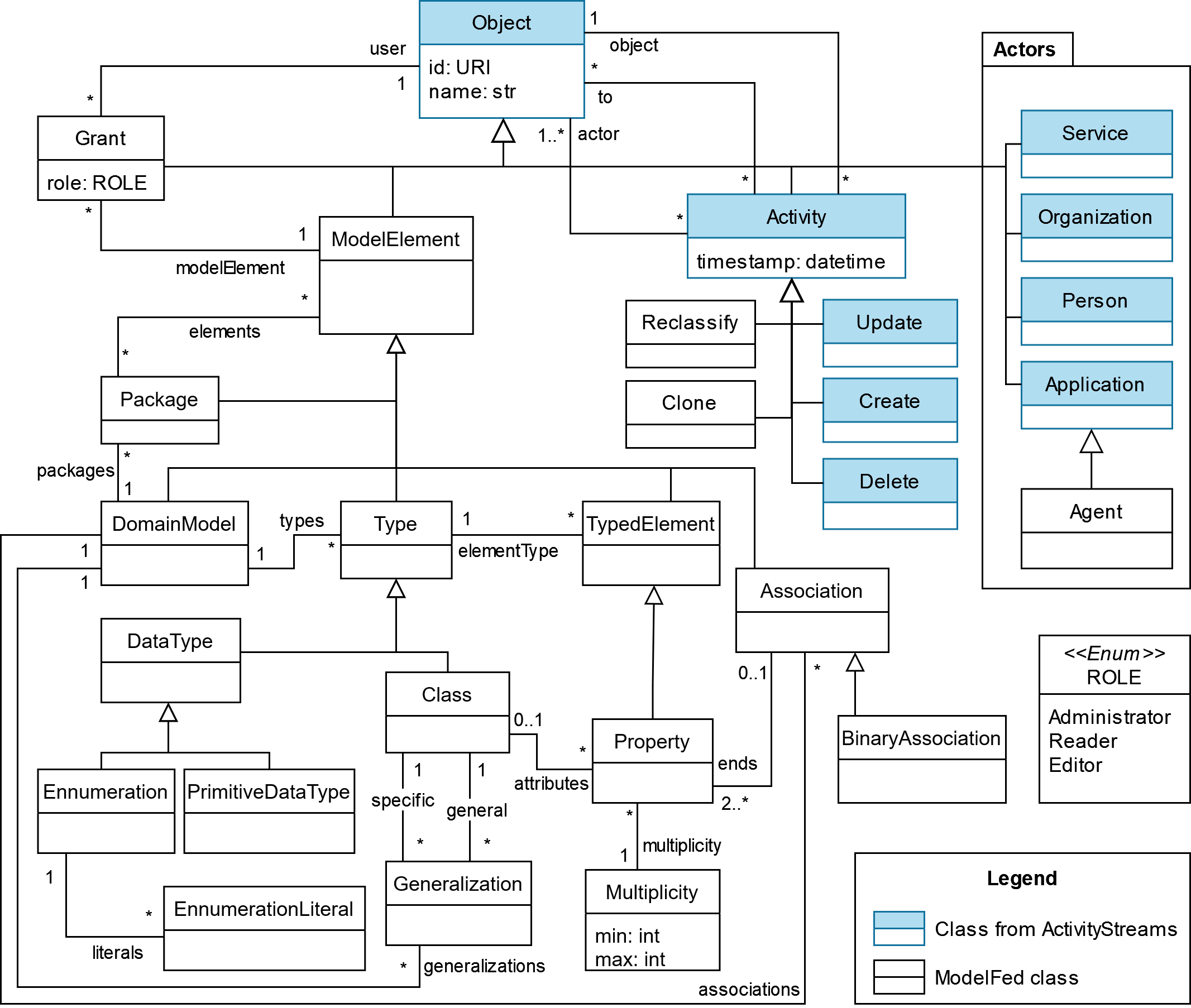
The following diagram shows the concepts of the ModelFed vocabulary and their relationships. Objet is the core concept of the ModelFed vocabulary, defined in the Activity vocabulary as an entity of any kind. Every Object, identified by a globally unique URI, falls into one of four main categories (*ModelElements, Activities, Actors, and Grants).
ModelElements#
ModelElement, which inherits from Object, is an abstract concept that serves as a general representation of any element within a model. The ModelFed vocabulary provides a pragmatic representation of the UML specification for structural models. Concepts such as Classes, Enumerations, Associations, and Generalizations can be defined to build a domain model. As an example, the following JSON-LD defines a class named ProductPassport with a string attribute (name). Note that every object includes an id for global identification and a type for object classification.
{
"@context": [
    "https://www.w3.org/ns/activitystreams",
    "https://www.modelfed.com/ns/modelfed"
],
"type": "Class",
"id": "https://platformA.com/classes/product_passport",
"name": "ProductPassport",
"attributes": [
    {
    "type": "Property",
    "id": "https://platformA.com/properties/name",
    "name": "name",
    "elementType": "str"
    }
]
}
Activities#
Activities enable the specification of actions performed on any Object. ModelFed defines five activities: Create, Update, Delete, Reclassify, and Clone.
The following is the definition of an Activity to create the LifecicleStage class. It includes:
@contextto define the vocabulary used in the JSON-LD document.typeto define the type of activity (in this case, Create).idto define the globally unique identifier of the activity.actorto define the actor who performed the activity.toto define the actors with whom the activity is federated.objectto define the object on which the activity is performed (the LifecicleStage class with the start attribute).timestampto define the date and time of the activity.
{
"@context": [
    "https://www.w3.org/ns/activitystreams",
    "https://besser-pearl.github.io/ModelFed/ns/modelfed.jsonld"
],
"type": "Create",
"id": "http://platformA.com/activities/a1c2t3",
"actor": "https://platformC.com/industrialeng/",
"to": [
    "http://platformA.com/admin/"
],
"object": {
    "type": "LifecicleStage",
    "id": "https://platformC.com/classes/life_cicle_stage",
    "name": "LifecicleStage",
    "attributes": [
        {
        "type": "Property",
        "id": "https://platformC.com/properties/lf_start",
        "name": "start",
        "elementType": "date"
        }
    ]
    "owner": "https://platformA.com/domain_model/dpp_model"
},
"timestamp": "2025-02-11T15:42:45Z"
}
Actors#
In ModelFed, Actors are the people, organizations, services, or applications that can perform activities within a model.
Each modeling platform participating in Modelverse must manage a basic set of information for every actor, as required by the ModelFed protocol:
id: A unique identifiertype: What kind of actor it is (e.g., person, service)name: A human-readable nameinbox: Where the actor receives shared activitiesoutbox: Where the actor sends activities to others
The following is an example of a JSON-LD document defining a Person actor called Materials Scientist.
{
"@context": [
"https://www.w3.org/ns/activitystreams",
"https://besser-pearl.github.io/ModelFed/ns/modelfed.jsonld"
],
"type": "Person",
"id": "https://platformB.com/materialsscientist",
"name": "Materials Scientist",
"inbox": "https://platformA.com/materialsscientist/inbox",
"outbox": "https://platformA.com/materialsscientist/outbox"
}
Actors collaborate by sending and receiving activities using their inbox and outbox:
The outbox is where an actor publishes activities they perform.
The inbox is where they receive activities shared by others.
This direct actor-to-actor communication is what powers federation in Modelverse, where there’s no central hub, just peers talking to each other.
Grants#
In ModelFed, Grants control who can do what. They define permissions for each actor, specifying which model elements an actor can interact with, and what kind of activities they are allowed to perform.
A Grant links:
An Actor (e.g., a person)
A Model Element (what they can access)
A Role (what level of access they have)
There are three different roles defined in ModelFed.
Role |
Access Level |
|---|---|
Administrator |
Full control (can edit, delete, and assign new Grants) |
Editor |
Read and write access (but cannot delete) |
Reader |
Read-only access |